


EU buyers asking for Hosted OpenSearch with data residency usually mean something precise: indexes and cluster storage should land in a European data centre that lines up with GDPR expectations and the geography named in the DPA — not a US default that security later has to unwind. On Logit.io that choice is an account-level data storage region, not a free toggle on every stack. Get the first stack right and every later OpenSearch or log stack in that account follows. Get it wrong after go-live and you need a second account, not a silent migrate button.
This walkthrough sticks to the live product docs: first-stack region lock, Stack Settings → Overview checks, the 14-day trial delete/recreate path, and when EU plus UK or US needs a second account. Pair it with the Hosted OpenSearch overview and OpenSearch pricing when you size a cluster. For the UK twin of the same mechanics, see UK data residency for Hosted OpenSearch.
Contents
- Why EU residency shows up in OpenSearch buying conversations
- Account-level region lock (first stack sets the default)
- Check the region on Stack Settings → Overview
- Changing region during a 14-day trial
- Second region = second account (when EU + UK/US both needed)
- Hosted OpenSearch + EU region + per-node pricing
- Failure modes / common mix-ups
- Get started
Why EU residency shows up in OpenSearch buying conversations
Continental European procurement rarely leads with “global multi-region flexibility.” They ask where personal data sits when OpenSearch indexes hold customer identifiers, access logs, or security analytics. Vendor questionnaires and customer DPAs often name the European Economic Area (or a specific EU member-state geography) as the allowed processing location. Logit.io’s docs treat that as a storage-region decision across Europe, the US, and UK regions when you add a stack — you pick a dedicated data centre for the account’s stacks so processing lines up with regional guidelines already on paper.
Your own office location does not force the region. The data storage regions guide is explicit: you can host an account’s data in any of the published regions regardless of where you or your systems sit. A UK- or US-based engineering team can still stand up EU Hosted OpenSearch for an EEA customer workload, as long as the account’s default region is set to EU before production data lands.
Compliance posture on the platform side is documented separately on security and compliance (including ISO 27001 and GDPR-aligned practices). Residency is still the account region setting; certifications and GDPR statements do not replace picking EU on first stack create.
Account-level region lock (first stack sets the default)
Region is not a per-stack preference you redefine every Monday. It is an account-level setting. When you create the first stack on an account — trial or paying — the region you select becomes the default for that account. Every subsequent stack added to the same account deploys to that default. The create flow for additional stacks does not offer another region picker; the UI simply places them where the account already lives.
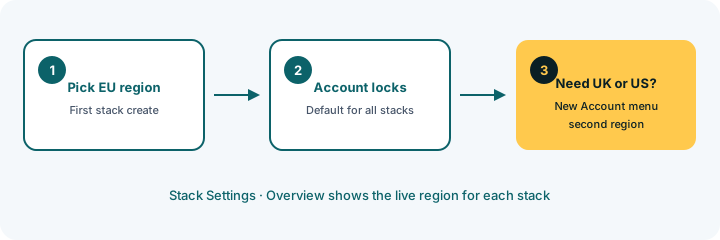
For Hosted OpenSearch that means the dedicated cluster you provision inherits the account region like any other stack type. There is no separate “OpenSearch-only region” switch. If the account default is EU, new OpenSearch stacks go to EU. If someone spun up the first log stack in the US during a hasty trial, your later OpenSearch cluster follows the US until you use a different account.
Need stacks in an additional region? The docs recommend creating a new account from the left-hand dashboard menu (New Account), then choosing the other region on that account’s first stack. Two regions, two accounts — billing and access follow accordingly.
Check the region on Stack Settings → Overview
Before you wire shippers or hand a region claim to a GDPR questionnaire, verify what the platform shows today.
- Account profile: Account Settings in the left-hand menu → overview / account profile shows the region selected for the account.
- Per-stack check: open the stack → Stack Settings → Overview. The overview lists which region that stack is deployed to.
Use Stack Settings → Overview when you manage several stacks and need confirmation on the OpenSearch cluster itself. If Overview and Account Settings both say EU, you are aligned. If they disagree with procurement’s assumption, stop ingestion planning until the account story matches the DPA.
Changing region during a 14-day trial
Trials are the only documented path to change the default without standing up a second account for production. On a trial account, the first-stack create screen includes the storage region selector. If you picked the wrong region, the documented fix inside the 14-day trial window is: delete the current stack, then add a new first stack and choose the correct default region.
That delete/recreate step resets the account’s default because you are effectively redoing first-stack setup. It also deletes the trial stack’s data — fine for empty experiments, painful if you already bulk-loaded indexes. Treat region selection as a day-one checklist item on the trial, before you invest in Logstash pipelines or OpenSearch index templates.
Paying accounts follow the same first-stack lock when the account is first set up. After that, additional stacks inherit the default with no region picker. Do not plan a production cutover that assumes you can flip EU ↔ UK or EU ↔ US on a live paying account from Stack Settings.
Unlock complete visibility with hosted ELK, Grafana, and Prometheus-backed Observability
Second region = second account (when EU + UK/US both needed)
Some programmes need EU residency for customer PII search indexes and a separate UK or US cluster for global ops telemetry or a UK-only subsidiary. Logit.io’s model for that is multiple accounts, not multi-region stacks under one login tree.
Practical pattern:
- Create the EU account first. On first stack create, select the EU storage region. Provision Hosted OpenSearch (or a log stack) there.
- From the dashboard, choose New Account for the second geography.
- On that account’s first stack, select UK or US as required. Deploy the second OpenSearch (or logs/metrics) stack there.
Keep credentials, API keys, and shipper configs scoped per account so EU personal data never “accidentally” targets a UK or US endpoint. Reviewers care about that separation as much as the region label on Overview — especially when a DPA names EEA storage and a Filebeat output still points at the wrong stack.
Hosted OpenSearch + EU region + per-node pricing
Hosted OpenSearch is the dedicated-cluster product: managed OpenSearch with Dashboards, API access, and node-based sizing. EU is one of the multi-region options already listed on the OpenSearch pricing page alongside US and UK — there is no extra invented geography beyond those published claims.
Pricing for dedicated OpenSearch starts at $45.52/node/mo on the published developer tiers (annual / developer node rates as shown on the OpenSearch pricing page). Cluster cost scales with node count × per-node rate. Separately, log management plans start from $25/mo, metrics from $12/mo, and APM from $20/mo on the public annual plan tables — useful when the same programme mixes EU Hosted OpenSearch with EU log or metrics stacks under one region-locked account.
Region choice does not change the from-$ amount. You pay the published node tier for the size you pick; residency is which account hosts those nodes. Planning assumption only: a two-node DEV-1-1-10 cluster is two × $45.52/node/mo on the published developer table — confirm current node sizes on the live pricing page rather than inventing capacity numbers here.
Failure modes / common mix-ups
- Wrong region after go-live. First stack was US; the DPA later requires EU. You cannot flip the live account’s default from Stack Settings. Plan an EU account, migrate indexes and pipelines, and retire the old account when ready — or stay on trial long enough to delete/recreate before production.
- Assuming per-stack region switches. Extra stacks never show a region picker; they inherit. Creating “just one more” OpenSearch stack will not give you EU if the account default is UK or US.
- Checking only Account Settings. Always confirm Stack Settings → Overview on the OpenSearch stack you will point shippers at.
- Mixing endpoints across accounts. Dual-region programmes need separate endpoints and keys. Sharing one Filebeat output across EU and US accounts breaks the residency story even when both accounts are correct in isolation.
- Confusing platform GDPR statements with residency. ISO 27001 and GDPR-aligned controls on the security page support trust; they do not auto-place indexes in the EU. The region selector does.
- Treating UK as interchangeable with EU. UK and EU are separate published storage regions. DPAs that name EEA storage are not satisfied by a UK-locked account — pick EU on first stack, or open a second account if you need both.
Get started
Start a 14-day trial, create the first stack with the EU storage region selected, then open Stack Settings → Overview and confirm EU before you ingest anything important. Read the full control path in the data storage regions docs. When you are ready to size a dedicated cluster, use the Hosted OpenSearch overview and the node table on OpenSearch pricing ($45.52/node/mo from the published developer tiers). If you already know you need EU plus another region, open a second account on day one instead of hoping for a later in-place switch.